
The AusumX Mission - Introduction:
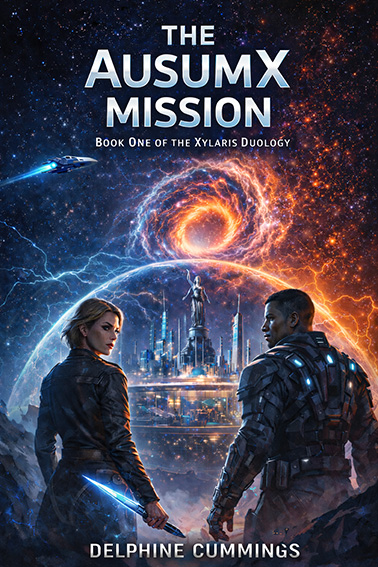
In 2084, Earth is losing millions to VX-23, an alien-coded virus with no lasting cure. When a wormhole opens above the planet and ejects debris from the distant world of Xylaris, scientists find traces of alien flora that may offer humanity one final chance.
AI engineer Kiana Benson is selected for the mission to retrieve it, but the stakes become deeply personal when Shelby Thomas, an autistic medical prodigy, arrives at her home hunted by the forces that destroyed her mother's breakthrough research. As rival factions battle to control the cure, Kiana is pulled into a world of sabotage, deception, and shifting loyalties. To save humanity, she must protect Shelby, survive the mission, and place her trust in an ex-Marine who may prove either her undoing or her strongest ally.
The links below provide samples for your enjoyment.
The AusumX Mission – Story Opening
July 13, 2084:
I can never forget the Tuesday evening when it appeared high above our Sitka Zone. It began as a swirling ball of energy—made me think of a Catherine wheel firework—then, over hours, it thickened and steadied into a perfect ring. From above the zone where I live, the mouth never wandered—parked in Clarke orbit at 140° W, the astronomers tell us. By day it glints like a coin; by night it’s a thin halo low in the south-southwest sky.
Clarke means high—about thirty-six thousand kilometers over the equator—yet in 2084 that isn’t far. With beamed-power shuttles and aerospike stacks you can make the climb from ground to GEO in under two hours, if you’ve got clearance. A few of the privileged, like Noel from AusumX, execs from the Institute For Humanity (IFH—a quasi-international NGO), NASA engineers, they’ve all done the run and bragged about the view. Fixed over 140° W and low on our horizon, it felt less like astronomy and more like a door someone had left ajar.
Every newsfeed on the planet carried footage. We couldn’t deny it. Earth had gained a space vortex—a wormhole to somewhere else. Even for a bytehead like me, who lives for AI algorithms, software, and dreams of orbit, it made me nervous. Where did it come from? What awaited us on the other side?
On that nothing-special Tuesday when it lit up the sky, Dad even pushed Mom’s wheelchair outside so we could all watch. Mom’s dying from cancer caused by the oncogenic VX-23 virus that showed up in the US more than twenty years ago. Now it’s killing off humans at an alarming rate.
Seeing the wormhole was surreal. It billowed and spun, colors shifting from ice blue to mauve to a searing white at its center. Sparks flew across the surface, and the air seemed to hum against my skin.
I tore over to the strolling area for a better view. Roads, wheel-based vehicles—gone years ago, the roads repurposed as wide pedestrian lanes and moving fastways—flat escalators that zip you across the zone without needing an airborne transport.
We murmured guesses about what it was, where it came from, what it meant. Dad wanted to head back in—worried the vortex’s fields might be impacting the systems at the Sitka AI Center, where he and Mom work. Eventually they started to leave, but I hung around.
“I’ll be in in a minute,” I told Dad, still mesmerized by the glowing ring in the sky that I was watching through the clear apex of our zone’s forcefield dome.
“Kiana.”
That one-word disapproval from Dad stirred a dozen emotions I didn’t want to feel. I remember wishing—again—that I had a sibling to share the burden of being parented.
“Yeah,” I muttered, trailing after them toward our dwell.
I was almost at the door when the screaming started. Our neighbors were shouting at one another and shoving to get back indoors. I ran back toward the strolling area. A violent thrust of fire and sparks was exploding from the vortex. Most of the meteor shower vaporized against the zone’s shield, but some fragments struck with brilliant blue flashes.
A meteor shower from a stable wormhole? Why?
Later we learned this meteor debris was tied to VX-23 wiping out humanity. Weeks of theories flooded the feeds. My uni friends and I discounted most of them, though I was much too busy with my university final submissions and exams.
In due course, following a serious amount of speculation on the socmed talk shows, NASA hurled a programmed probe into the vortex mouth. The wormhole swallowed it and then we waited. It wasn’t too many days before the wormhole spat the probe back out again, as planned.
Beyond the wormhole is an Earth-like planet, NASA informed the world. Hostile but habitable, with hyperactive volcanic activity that explained those blue meteors. Scientists named this planet Xylaris. And here is the real news: some of those meteor fragments carried spores and tissue from flora that appear to fight the virus killing humans on our planet, on Earth.
The IFH wasted no time. They proposed an international mission to Xylaris to find this flora and bring it back home. Basically, they planned to have the pharma companies create an antiviral remedy to stop VX-23 from harming humans.
In no time the IFH received international recognition as the approved body to run the mission. the U.K., India, the African Union, Russia, China and Europe participated, though in reality, the U.S. maintained their grip on power with their dollars. “We pay, we say.” And sure enough, who did the IFH partner with for their mission: Solwin Pharmaceuticals. Main shareholder of Solwin: Prescott Jones. CEO of IFH: Prescott Jones.
The IFH started their search for the right candidates for their mission. Ads went out to the top industries and universities in the search of scientists, professors, research specialists, and experienced people in specific disciplines. Those like me and my friends, young, healthy and virus-free dominated the applicants for obvious reasons.
Only fifty were needed across the globe. Even with Earth’s shrinking population, it sounded small. Then the IFH’s tours started. Posters on our campus made it look like a blood-donation drive—except it was our lives on the line.
I was in my last semester of AI engineering at Sitka Uni. Graduation day was supposed to be my ticket to a career designing neural nets for autonomous systems. I already had won a fab position at AusumX, in charge of a section of their AI systems. During one of several interviews, they told me I was competing with some of best AI candidates in the US. Instead, before I’d even enjoyed day one in my dream job, I found myself standing in line to register as a qualifying candidate for this dangerous Xylaris mission. It wasn’t as if I could skip out. Run away. In 2084 our lives are controlled to the minute. Days after birth, an ID chip is installed adjacent to the heart in all babies on the planet. Everyone is watched, tracked, and logged. Even in a university my chip maps my every move—who I sit with, what I study, maybe how many heartbeats I have left before the virus wakes inside me.
So, I submitted to the tests. Firstly, we had to speak decent, understandable, technical level English for our disciplines. This ruled out lots of graduates from other countries. Then came medical, psych, and neuro-screening. My GPA didn’t matter if my body and grammar didn’t pass muster. Across the world, thousands of us stood in those same lines, most of us praying we wouldn’t be picked for the final fifty. But even those left behind were still on the hook for service, just in less risky roles.
You’re getting the picture, right: perfect age bracket, top drawer uni, award-worthy GPA in AI engineering, top job with Noel’s AusumX company–quals to die for on this mission. I guess it was inevitable.
The pressure at home was worse. Mom’s virus-caused cancer made the “cure” personal. Of course I wanted to find a cure for my mom. Dad broke down the likelihood of my selection in cold statistics. We didn’t get to discuss whether I’d go if a green light glowed over my application—the IFH made that choice for me. What we talked about was how to survive the training, the blast into space, the wild journey through the wormhole to a different galaxy, and so on. Yeah, a lot to take in.
And that’s how, three months later, on my twenty-first birthday, I found myself staring at the selection board on IFH’s website, my future no longer my own.
The AusumX Mission – Solwin Mining Company
A transport with SMC (Solwin Mining Co) emblazoned in red and black letters on its side lands in the clearing. Two security bots unfold from the transport. I stare at their insect-lean, basalt-matte frames with red SMC chevrons on their breast plate. Unlike Bane’s smiling face, these bots have a slit of sensors and a ring of micro-lidars.
Each bot carries a forearm shock-web, hip baton, and yes, laser weapons. As we learned in kindergarten security bots are allowed to harm humans in their line of work. I flick a glance at Shelby since she looks like she might faint. Thankfully Aimi steers her away from the clearing.
Marlowe steps forward, placing himself between the security bots and the rest of us. I like to believe Marlowe can overpower a whole army, if he can keep his balance in the waves. The bots look past Marlowe—straight at Shelby. Her skin has gone pale with that chalky undertone that comes from deep-rooted fear. Bots like these can analyze a dozen biometric cues in the time it takes me to blink. Though it isn’t helpful, I’ve always hated them.
No one has hiked this mountain range in decades. Finding this mine was an accident. I keep telling myself this, as if I’m the one who needs convincing, even though I know someone engineered it to bring trouble to our door.
Are these bots going to arrest us? I won’t be able to resist any more than the golfer in our Sitka Park. If that happens out here in the freezing mountains, we’ll lose our chance to find meteor fragments. Besides, what can Allan or Noel do if we’re flagged for trespass? What if we’re booted from the team? My arugula and tomato sandwich feels heavy in my belly.
Even more pressing, if we’re out, Mom’s antiviral meds are gone. The President’s help—if there ever was any—will be revoked. My last hope snuffed out.
“How can we help you?” Marlowe says calmly to the SMC bots.
“Citizen Marlowe McDonald, please explain why eight persons from the Xylaris Space Mission project are trespassing on our mining operations, making holos of our operation?”
“We are on an outdoor challenge,” Marlowe says. “We had no idea this was mining property. There were no signs. No fencing.”
“Ignorance is not an excuse. Why did you not consult GPS overlays? You and your group have violated several laws. Surrender your quants, backpacks, and anything in your pockets, then come with us. We have medical facilities for the sickly-looking girls near those trees.”
“We’re not sickly,” Aimi asserts.
“No way,” I say, moving closer. “We’ve done nothing wrong. We didn’t even know this mine existed. We’re part of the Xylaris mission to find a cure for the virus. This outdoor challenge is part of our training.”
“You will do as I say,” the bot repeats. It picks up and crushes a rock the size of my head with its claw. “Or I will make you.”
“Shit,” Viktor mutters, surging forward.
Marlowe lifts a hand, giving us a subtle signal. Don’t escalate.
The robot presses a sliver of the crushed rock against my neck as it yanks my quant and receptacle free from its clasp. My throat tightens. This small piece of home belongs to me. I always looked forward to leaving home, even though it was the happiest of times. Now I cling to simple memories: Grandma’s locket, my lovely quant receptacle, Dad’s concentration exercises, Mom’s recipes.
When I refuse to surrender my pack, saying it’s only food and camping gear, the robot rips the strap with one brutal jerk. Then it cuffs me. I don’t resist when its metal fingers pat down my jacket before leading me to the SMC transport, but I glance toward Marlowe. He shakes his head again.
“First time for everything,” I mutter, my voice shaky.
As one bot collects our gear, the other secures each of us.
“Hold on,” Marlowe says. “We’re here under the authority of the US President Steinway.”
“Citizen Marlowe, this is SMC Mining Co land. Your team holds no jurisdiction here. Stand aside.”
The bots scan us again, no doubt making their full threat assessment in under a second. They can predict our escape routes, measure our speed, estimate our odds. It’s no win, always.
“Not a chance,” Xian says, striding up with a pair of metal cutters. I thrust my wrists toward him like Oliver Twist begging for gruel.
He snaps my cuffs.
The bots charge him, inhumanly fast and full of robotic certainty. But Xian bears his own surety: ropey muscles, black belt edge, snatch of Marlowe’s poise. I flick my eyes across the clearing. Viktor and Juno are scanning for weapons. I signal Cypress to protect Aimi and Shelby.
Suddenly, Xian whirls, cuts Marlowe’s cuffs, then tosses him the cutters. I feel a surge of hope that we have two aikido masters tackling the security bots, but it’s still not a fair fight.
A bot grabs Marlowe’s arm. He twists away, using the bot’s force against it, but its grip is brutal. Blood drips from his arm into the dusty ground. I feel sick to my stomach as I dive for the bot’s back, desperate to help. With my arms around its neck, the three of us struggle one way and the next.
“You metallic tronk,” Marlowe growls, his arm still tight in the bot’s claw.
My own arm hurts as if it is being twisted. The bot refuses to let go then with a flick it throws me to the ground. I’m getting back on my feet just as Xian jumps on its back, covering its sensors, shouting something in Chinese. Still the bot won’t release.
The other one lifts a rock.
“Juno!” I scream.
Juno dives. The boulder misses his head by inches. He rolls and pops back up, agile as ever. Thank God. I thought I hated him—maybe I don’t. Yes, I hate his swagger, his games, the way he needles me. But right now, he doesn’t hesitate. He saves people. That . . . I can’t hate.
The bot raises another rock. This one smashes into Juno’s foot. I suck in a fast breath. He cries out, but he’s pissed. Cypress throws her jacket over the robot’s head. It thrashes, blinded. She refuses to let go the jacket as Viktor jams his stake into the bot’s back. Juno does a sliding tackle, sweeping its legs. It faceplants. Juno karate chops a backwards waving arm. I rush over, flipping open the panel with shaking hands. This is why I studied robotics, why Allan trusted me to master overrides. If I panic, someone dies.
The bot dies.
“Done,” I murmur.
We turn to the other fight.
The second robot, rock shards in both claws, isn’t falling for the same tricks.
Viktor tosses two of our stakes to Xian and Juno. Then charges in himself.
Xian spins like a dervish. With a yell, he cracks one leg. Juno smashes the other. As Viktor moves in for a third blow, the bot hurls both rocks.
One Viktor deflects. The other slams into his shoulder. He crashes to the ground, groaning.
I grab his stake, pausing a split second for Juno so we can double-strike the bot. Facing new attackers, the bot finally lets go of Marlowe’s arm.
My relief is huge.
Marlowe seizes the moment. He lifts the cutters and cuts through one of the bot’s arms. Its other hand grabs the cutters from Marlowe and uses them to strike back at Marlowe. He crumples.
Viktor is also down, so Xian, Juno and I use our wooden stakes to strike hard at the bot’s legs. It falls.
I have seconds to act. I leap on the bot before it can get up and I bang open its panel. Juno and Xian are jumping so hard on the bot to stop it getting up that I can’t enter the code.
“Don’t jump,” I scream.
In the brief lull, with the bot thrusting itself upright, I manage to enter the complex set of override codes. The bot twitches and dies.
I fall back, shaking. “Wow.” With my hand pressed to my stomach, I pant hard from the physical and emotional exertion. “Holy frap, that was one hard fight.”
We’re all breathing hard and no one is moving. For a moment my head hangs limp.
“Nice work team,” Marlowe says, finally.
Viktor is still cursing in Russian, gripping his shattered shoulder. Xian is bent over, holding his stomach, panting hard.
Juno gets up then offers me a hand. Back on my feet, I watch him hobble towards Aimi. Shelby has already pulled out her medical kit.
Cuffs dangling from my wrists, I stare into the clearing at the mess we’ve created. Two dead bots lie face down in leaf litter and the ground is scattered in metal limb pieces, cuff chunks, bits of rocks, and the stakes that Marlowe insisted we prep and which have just saved us.
Is this what mob butchers feel at a crime scene? Wiping blood from their knives, dabbing white handkerchiefs to spatters on their fancy suits. It’s hideous. These metallic body parts could easily have been our flesh.
It can’t be a coincidence that Prescott Jones, former head of Standard Oil, is an owner of SMC, as Vyra confirms. Then there’s Susan. It all connects.
We cut off the rest of the cuffs and retrieve our gear. My fingers tremble when I clip the quant back onto my wrist. It’s more than a keepsake now—it’s proof I’m still standing. If I can’t lead myself through this, I can’t lead anyone else.
I scan for anything we left behind, deciding a sandwich crust can stay tossed. Nothing can hide this day’s actions.
Aimi, Cypress and I haul bot pieces into the SMC transport while other team members get patched up. Shelby works quickly, her hands steady despite everything. She binds Marlowe’s arm, stitches Viktor’s shoulder, wraps Juno’s foot.
Thank God she’s coming to Xylaris.
We pack as fast as we can, keen to leave Solwin Mining Co’s land far behind us. Part of me wants to hijack the transport, but we leave on foot, wounded and shaken as we hike toward the planned area for our campsite.
We’ve got proof of industrial poisoning, but who can we trust with it? With the power structure as it is, we’re pawns. And pawns are expendable.
Still, we’re not here to expose mining waste. We’re out here to test our skills at hiking and finding meteor fragments. We’re here to prepare for Xylaris. To find a cure for Earth. For my mother—if I’m not too late, and for me. Now I must include myself in this virus equation.
We cross the creek using standing stones, then climb a trail of brittle brambles and loose rocks toward the plateau.
Climbing proves harder than expected. My thighs and buttocks scream. By late afternoon, I’m exhausted. We reach a resting place where I collapse backwards onto a huge boulder, the cold of the granite seeping through my suit.
The thought slides in before I can stop it. What if this isn’t just being out of shape? What if it’s VX-23, whispering its future at me? Mom is already losing ground. I can’t afford to as well. I’ve stared at my irises in the mirror more times than I’ll admit, half-expecting to see frost tracer lines creeping in. Once they show, there’s no going back.
“Everything hurts,” Aimi moans.
“Groin, shoulders, back, shins,” Cypress lists. What muscle doesn’t hurt becomes a sad joke.
“We’ve never used our bodies like this before,” Marlowe says. “Born inside zones, walking on fastways, riding in FasTrans, prescribed sports, but no hiking. No climbing over rough ground for hours, no scrambling up creeks all morning and now cliffs—”
“—or down,” Cypress snaps. “Why the bleep does going down hurt so much?”
“I swear I’ve bruised my shins,” Aimi says.
I tear off a chunk of a chewy bar I grabbed from the Mission Center kitchen. The dried fruit with hand-ground nuts and seeds sticks in my teeth. I wonder what fruits and seeds we’ll be eating on Xylaris.
“Let’s take a thirty-minute break before resuming,” Marlowe says.
Most of the others groan.
I curl up with my head on my backpack, arms wrapped across my chest to stay warm. Isn’t feeling cold one of the signs of this VX-23 virus?
The day is almost over, and higher on this mountain the wind has turned sharp. If we can’t find the plateau soon, pitching tents will be hopeless. If I knew about such things, I’d say I felt a change coming in the weather. Perhaps snow.
“You okay?” Aimi asks, her voice soft as moss.
“I’m good, thanks. Let’s check the map.”
My mind turns to Juno, because he’s starting to confuse me. I sense something has changed in him, for the better, though I can’t figure out what it is, and that bothers me.
As we wait for Marlowe and Xian to return from scouting, Aimi and I pore over the map trying to make sense of where we are. Dead trees and granite boulders look the same after dozens of ups and downs. It’s a wild guess where we’ve stopped. We crossed the creek early afternoon. Since then, we’ve climbed and traversed other valleys with similar creeks.
“These suits are ridiculously tight and cold,” Cypress says, tugging at the fabric. “Why can’t we wear our smartfab things?”
“Because they’re not waterproof or impact-resistant,” Marlowe says, rejoining us. “Good news. Over this next ridge, we can see the plateau. We’re nearly there. Only another couple of hours.”
“A couple of hours,” Cypress shrieks. “My body can’t take that. It’ll be dark in way less time. One of us is going to fall down a frapping chasm.”
“I don’t want to fall in a chasm, Marlowe,” Shelby says flatly. “If you think I’m the one who will fall, I’d like to know. Then I will walk more carefully.”
“God, what a moron,” Cypress mutters.
“Shut your trap, wise ass,” Viktor growls.
“Enough. Be respectful.” Marlowe says.
We leave the clearing carrying proof of corporate poison and the broken shells of two dead robots behind us. But the image of their crushed rock weapons and Shelby’s pale face stays with me. We’re in deeper trouble than any of us want to admit. Today, we fought together—Marlowe, Xian, Viktor, Juno, all of us—and somehow made it through. That matters.
But the odds won’t always be on our side.